
Airports: partner with Amagi
Plan vertiport and charging infrastructure for drone delivery and emergency eVTOL, with a consulting partner that knows airport construction and electrical procurement.
What a vertiport can mean for your airport
Amagi’s model is meant to add activity and connectivity without inventing a new aviation footprint from scratch.
Community connectivity
Help link nearby communities with shorter air links where road travel is long, while staying on airport property with existing aviation use and established airport zoning.
New aeronautical activity
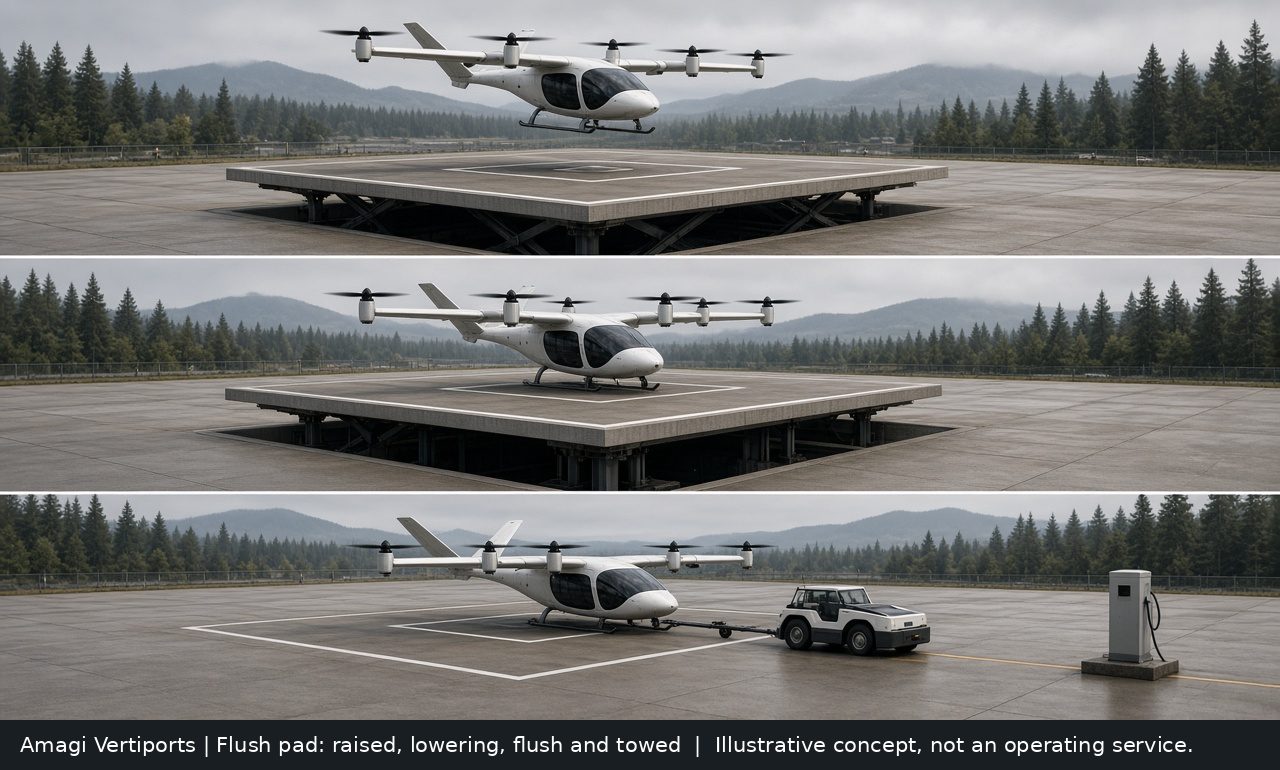
A compact pad, chargers and stalls designed for electric aircraft and drones: additional aeronautical use on land already dedicated to aviation.
Design targets, not results
Each site is sized for approximately 20 eVTOL round trips per day and 50–100 drone flights per day as design targets, not operating results or commitments.
Emergency eVTOL and medical drones
Our focus is drone delivery, starting with medical and parcel, plus eVTOL for emergency services. Concepts only: no dates or agreements are implied.
Use of the existing aviation footprint
We site at existing airports so improvements can build on existing aviation use and established airport zoning, rather than seeking greenfield sites.
What shared use could look like
In concept, a public agency or medical provider would fly from a quick-response stall at the vertiport, under its own approvals, while Amagi provides the pad and charging on airport property.
Concept only: no operator, agency or service is lined up.
How it works: private developer, airport landlord
Amagi raises private capital and leases land at your airport under a long-term ground lease, typically 30–35 years. We design, build and operate the vertiport. Your airport puts up no construction capital.
Amagi’s role
- Raise the private capital
- Designed to EB 105A criteria
- Operate and maintain the vertiport for the life of the lease
- Earn revenue from landing and charging fees, drone hub leases to operators, and terminal and concession space
The airport’s role
- Landlord under a long-term ground lease
- Earn base rent plus a percentage of vertiport revenue
- Keep its existing FAA obligations; rent is set at fair market value
- Review and approve the site plan through its normal process
Grants are separate. Any federal or state grant is the airport’s own decision and goes through the airport’s own competitive process. Amagi’s improvements are privately funded. No airport agreement or funding is in place yet; terms are subject to a written lease and FAA, state and environmental review.
A repeatable package for airport partners
Standardized modular design
- Terminal for passengers and operations
- Drone delivery hub to host drone delivery operators (medical supplies, small parcels), separate from the passenger pad: see drone delivery
- Adapted to each airport’s footprint
Design, advisors & outreach
- Layout design for a repeatable vertiport, designed to FAA Engineering Brief 105A criteria
- Regulatory advisor support: a part-time ex-FAA advisor is a planned hire, not claimed as hired today
- Partner outreach to operators and stakeholders as the network develops
20 Washington airports screened
We have completed a site screening of 20 Washington airports for vertiport and charging fit. We share results directly with each airport.
Charging first
Our screening and planning work aligns with WSDOT’s initial focus on charging infrastructure.
Forward-looking plans and timelines are goals, not guarantees.
Need help before committing?
For airports that want answers first, we also offer consulting on site screening, concept layouts, power planning and funding strategy. We can also help add vertiport and AAM elements to your master plan and Airport Layout Plan (ALP), which can help position projects to pursue grant funding. Eligibility is determined by the FAA and WSDOT. See consulting services.
How we screen airports
A simple screen, not an application. If most of these apply, we would like to talk.
What we look for
- Room for a pad, chargers and a separate drone area without crowding the runway
- Interest in advanced air mobility for passengers, emergency use or drone delivery
- Willingness to discuss a long-term ground lease (low base rent plus a share of revenue)
- Support from the airport board or ownership
What we need
- A site plan or aerial of the candidate area
- Any known FAA grant assurances or Part 139 obligations
- A point of contact
What you get
Amagi raises the private capital, designs and builds to EB 105A criteria and operates the site. Your airport earns rent and a revenue share without construction cost.
No airport agreement or funding is in place yet.
Start a conversation
Airport managers and owners: tell us about your airport, or read the airport brief.
Email: amagienergy@gmail.com · Phone: 425-244-7504 · Camano Island, WA